
CEBENE

THE VINEYARD
The Domaine de Cébène produces wines with a strong connection to the land, both intense and delicate. Situated on the heights of the designated natural site of Faugères, within the Regional Natural Park of Haut-Languedoc, this 11-hectare estate is perched at an altitude of 300 meters. The majority of the vines face north and have an age range from 20 to over 70 years.
Brigitte cultivates her vineyards using organic farming practices, creating a captivating panorama across terraced slopes. These terraces are surrounded by vast forests of scrubland and oaks, nestled in the heart of the Faugères vineyards.
One of the outstanding characteristics of Brigitte's Cébène terroir arises from its profound foundation—an outcrop of schist without any other rock types, combined with a thin layer of organic matter on the soil's surface. This unique arrangement encourages the vines to establish deep roots, sourcing resources from the fissures within the layers of schist. This trait instils a sense of modesty in the vines, guaranteeing a steady water supply and sheltering them from the unpredictability of the climate.
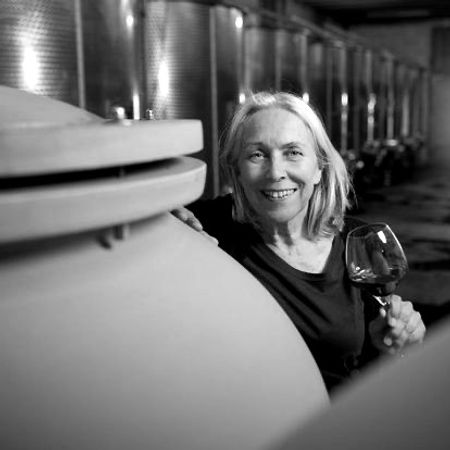
BRIGITTE
After spending a wonderful two decades diving into the world of wines in Saint-Émilion, Brigitte Chevalier decided to follow her heart and move to Faugères in 2007.
With a dream in her heart and a love for making wine her own special way, Brigitte took a brave step forward all on her own, without any fancy inheritance or big support. She's like a wine magician, bringing her personal touch to every sip!
Originally from Languedoc, Brigitte wanted to go back to her roots and make elegant wines with her own twist. She started by picking out a beautiful spot in Faugères, a bit secluded with four hectares of vineyards facing the north. The place sits high up at 300 meters, giving the vines a cool breeze and a stunning view. In 2014, she even built her own cellar right there – talk about dedication!
Brigitte Chevalier might be a humble soul, but her wines are like a piece of art. They perfectly capture the fresh and delicate flavors of Faugères, especially its cooler side.
CLOS CONSTANTIN

THE VINEYARD
Clos Constantin rests at an altitude of 230 meters, nestled in the heart of the captivating garrigue landscape within the charming Languedoc village of Argelliers.
It's perched on the Larzac terraces, offering an awe-inspiring view of the majestic Pic Saint Loup mountain.
The winery spans across 15 hectares, divided into multiple small plots, each with a unique character. Two distinct terroirs stand out:
- "Les Champs Traversiers": Here, a cooler climate mingles with clay-limestone soils, crafting an ideal setting for crafting white wines.
- "Font Belette": This spot enjoys more sunlight and is embraced by the sheltering presence of an olive grove. It's perfect for producing our red wines.
At Clos Constantin, serendipity is not part of the plan. Every detail is thoughtfully considered. The soils are tended with reverence for the living ecosystem, while grapes are harvested by hand and gently placed in small crates.
They believe in minimal interference, practicing a homoeopathic approach to using sulphur.

PIERRE & SAMUEL
At the beginning, there's Pierre Halley. In 2009, he returns to his homeland after a trip to the United States. Slowly but surely, he takes over his uncle's vines.
These vines used to contribute grapes to the cooperative.
In 2010, Pierre begins producing a few hectolitres in his garage, giving birth to Clos Constantin.
This is his way of honouring his great-grandfather, Constantin.
In 2015, Pierre is joined by his friend Samuel Durand, who used to be a sommelier in Paris.
Together, they start building a wooden cellar right in the heart of the garrigue. The concept of Clos Constantin becomes a reality, dedicated to Pierre's great-grandfather, Constantin.
The full-fledged project comes to life in 2016.
By 2017, they transition Clos Constantin to organic farming practices.
LES EMINADES

THE VINEYARD
Luc's and Patricia's estate has been tended organically since the beginning of 2002. The culture of the vine is done with the greatest respect for nature, without the use of pesticides. They do as much naturally and by hand as possible.
Their picturesque old vines line up across dry stoney hillsides around the villages of Cébazan and Villespassan. The altitudes of the plots vary between 170 and 300 meters, providing a variety of wines.
Their vines are mostly made up of very old Carignan (planted in 1902), Grenache Noir (from 30 to 60 years old), Syrah and Cinsault (from 30 to over 60 years old), Grenache Blanc (planted in 1991), Marsanne and one hectare of Sauvignon.
In 2003, 2004, 2006 and 2007 they replanted Syrah and Mourvèdre.

LUC & PATRICIA
Luc and Patricia met in Toulouse during their studies, Oenology for Luc and Pharmacy for Patricia, during a fateful Initiation to Wine Tasting evening.
It was in 2002, after various professional experiences in several French wine regions, that they actualized their wish to stand on their own two feet by creating their estate.
The move to Cébazan was done on a real crush for the region's mosaic of terroirs, old vines and people. Luc and Patricia have a real desire to make different wines without worrying about trends or marketing. They make wines that they like, and above all they make wines to give pleasure.
PAUL MEUNIER CENTERNACH

THE VINEYARD
Domaine Paul Meunier harvested its first vintage in 2014.
Ten hectares of old vines of various terroirs in the Agly Valley, in the villages of Maury, St Paul de Fenouillet, Lesquerde and Centernach, the heart of Roussillon.
Vineyards are integrated into their natural environment, organic farming, permaculture, without insecticides.

PAUL & LUCILE
Paul is the son of Burgundy winegrowers.
He discovered the Agly Valley during his training in 2009: it was the beginning of a love story with the landscapes and the freedom of the wines. For 5 years he worked for other winegrower/winemakers and discovered the vineyards and wines of Japan, Chile, Portugal, Australia, Lebanon.
Lucile joined the estate from the first harvest in 2014 and quickly got implicated in all the works. From her experiences as an actress, she brings an artistic and cultural vision of wine, which results in the original communication
of the vineyard.
Lucile's other quality is that she doesn’t come from the wine world, so she gets a fresh look at wines and vines. It is undoubtedly this freshness that allows her to launch the production of dry Rancio in 2017 or to develop agroforestry on the estate.
Today Lucile and Paul are building the domain together: the alchemical equation is complete, and time does its work.